Self-hostedNostro / GLMobile moneyCard schemesBilingual EN / FRUnlimited users
Your data stays yours
Mandatory TOTP login
Tamper-evident audit log
PCI-DSS scope reduction
Bilingual EN / FR
kilter · your-bank.internalLive
01 / 06
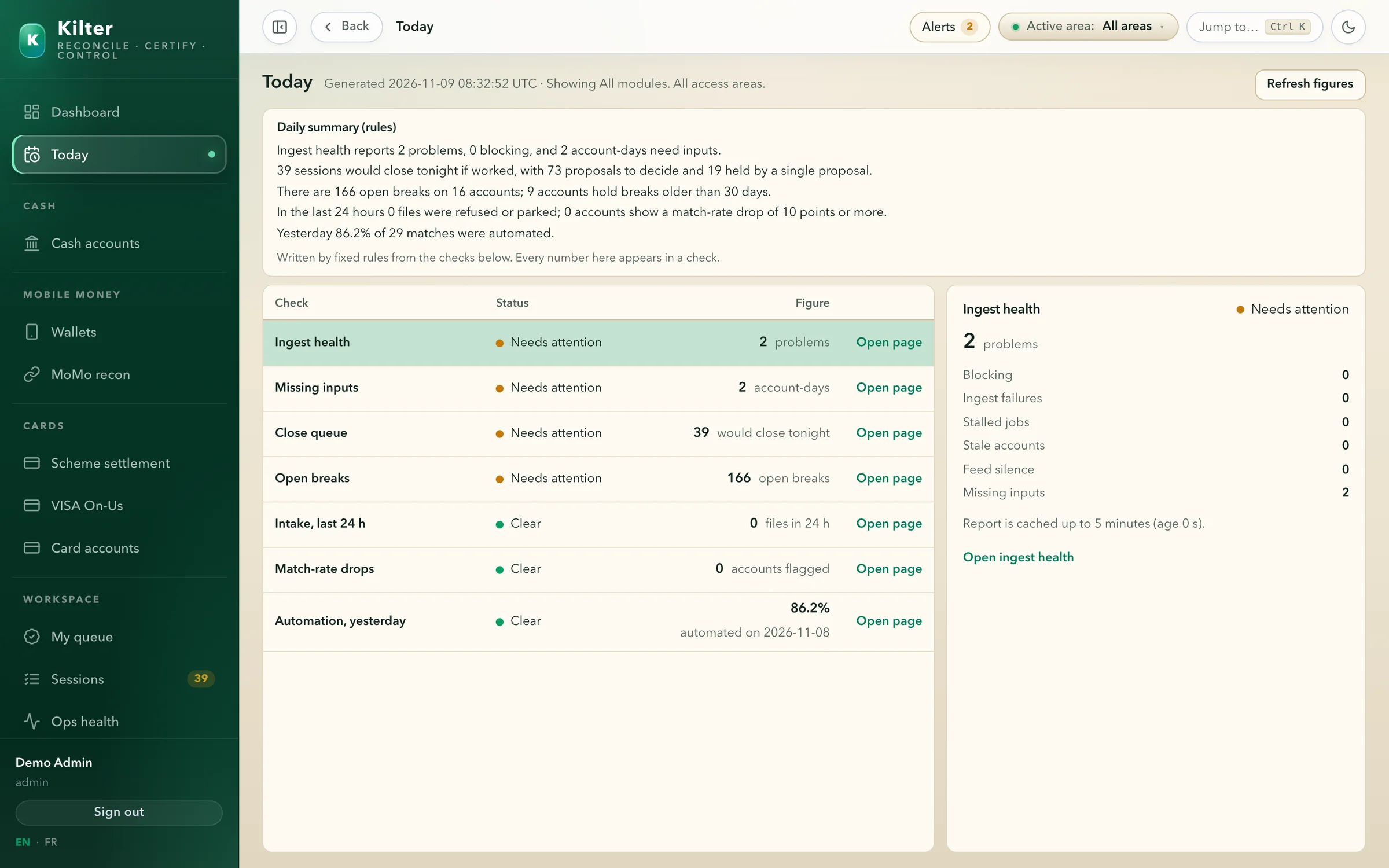
Today
Start-of-day view: what needs attention before you open a queue.
Home board
Kilter / reconciliation streams
Nostro / GLSWIFT vs core GL
Mobile moneyOperator B2W / W2B
Card schemeVisa · Mastercard · GhIPSS
Nostro / GL
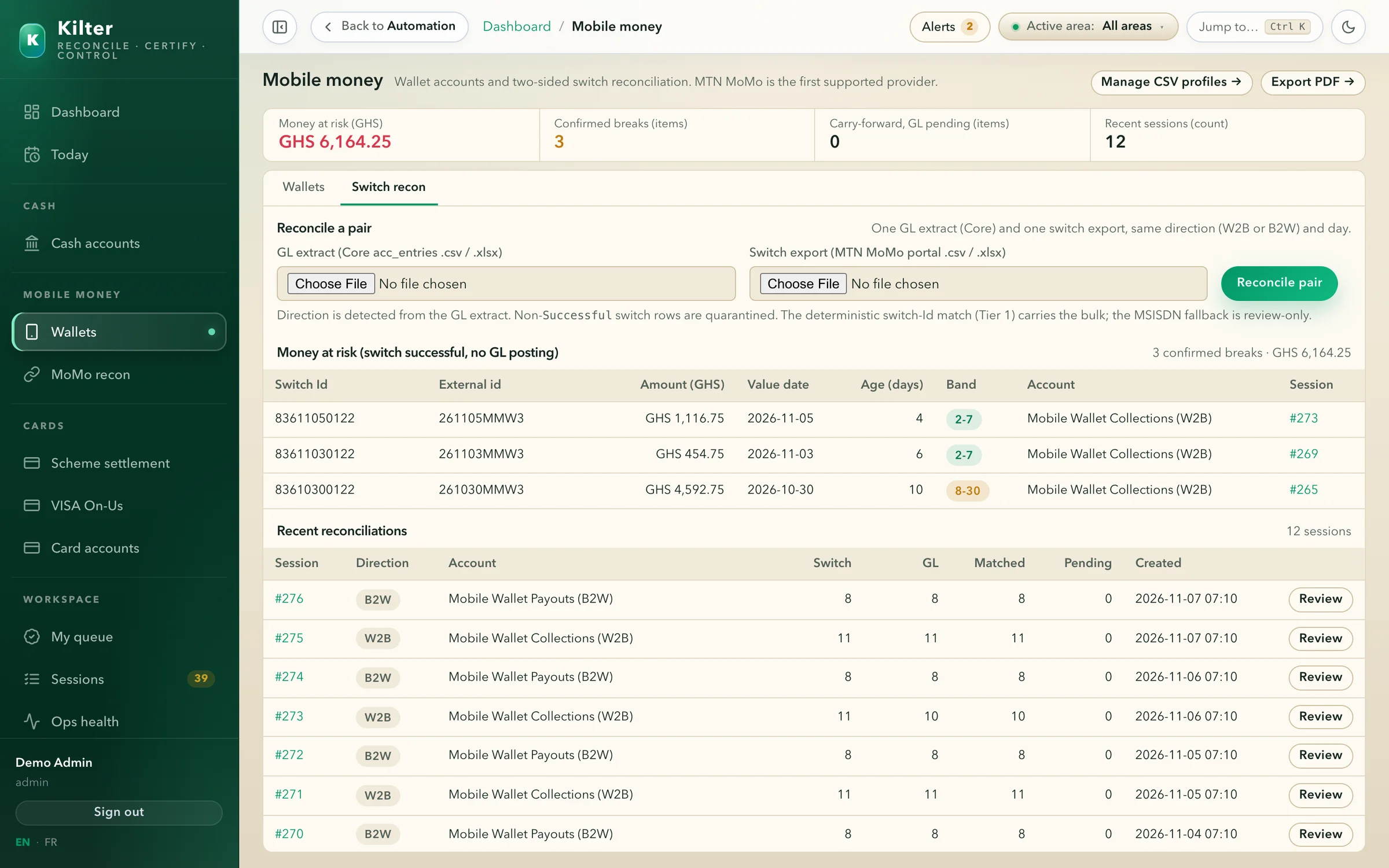
Mobile money
Card schemes
Securities / CSD holdings
SWIFT MT940 / 950 / 942
camt.052 / 053 / 054
SFTP / IMAP auto-pull
Tamper-evident audit
Mandatory TOTP
Self-hosted
No telemetry
PostgreSQL
Bilingual EN / FR
Unlimited users
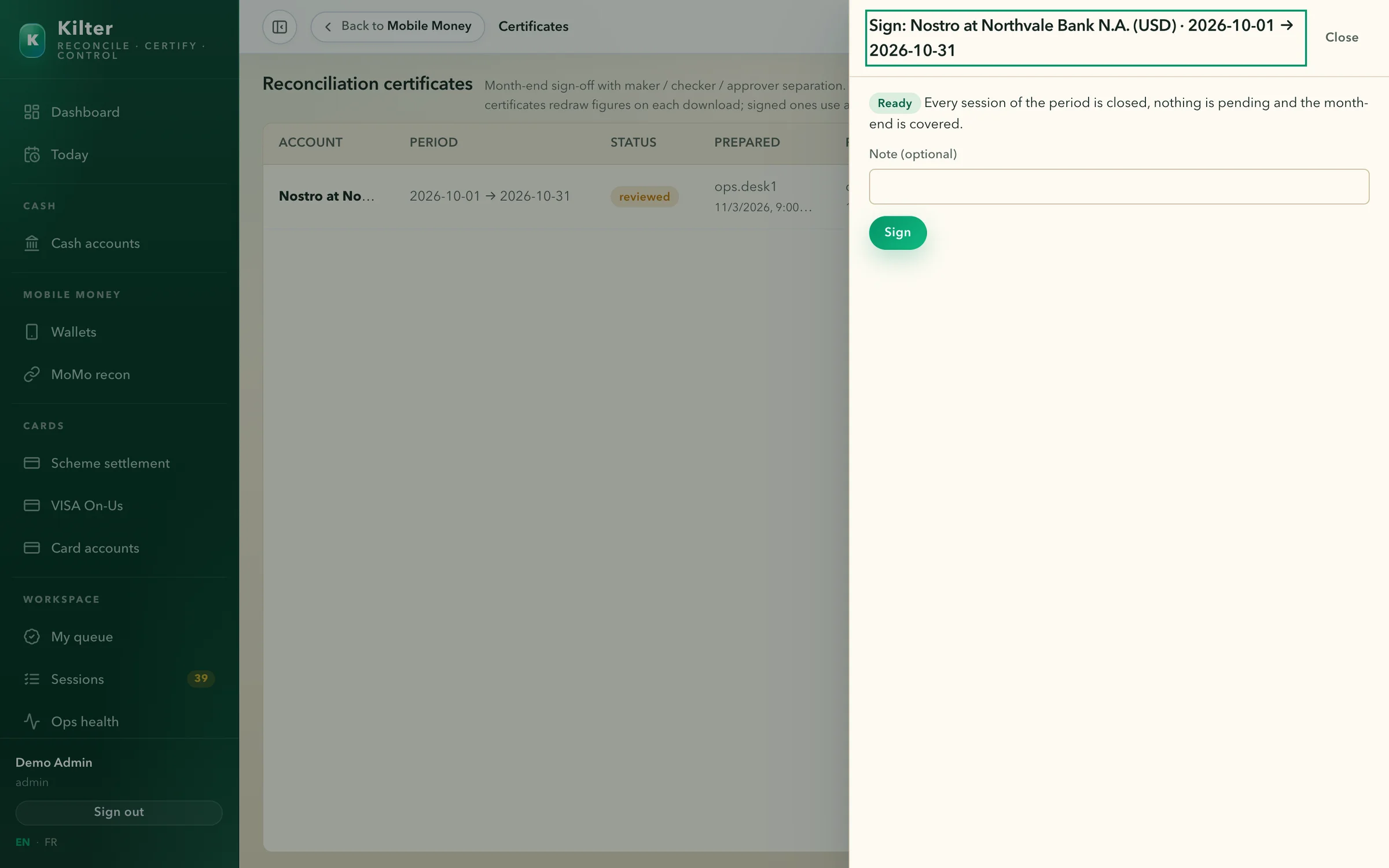
Month-end certificates
Nostro / GL
Mobile money
Card schemes
Securities / CSD holdings
SWIFT MT940 / 950 / 942
camt.052 / 053 / 054
SFTP / IMAP auto-pull
Tamper-evident audit
Mandatory TOTP
Self-hosted
No telemetry
PostgreSQL
Bilingual EN / FR
Unlimited users
Month-end certificates
By the numbers
Proven on real correspondent-banking volume.
75–85%
Auto-matched at Tier 1
hands-off, on production data
4 → 1
Recon tools replaced
nostro/GL · mobile money · cards · securities
$0
Per-seat fees
unlimited operators, every plan
100%
Decisions audit-logged
tamper-evident, every action
Auto-match rate observed in production at a West African commercial bank; figures vary by data quality and tier policy. Kilter is self-hosted — your data never leaves your infrastructure. Read the field report →
What's new
What's new in Kilter 1.0.12
Six changes operators and auditors will notice first.
New
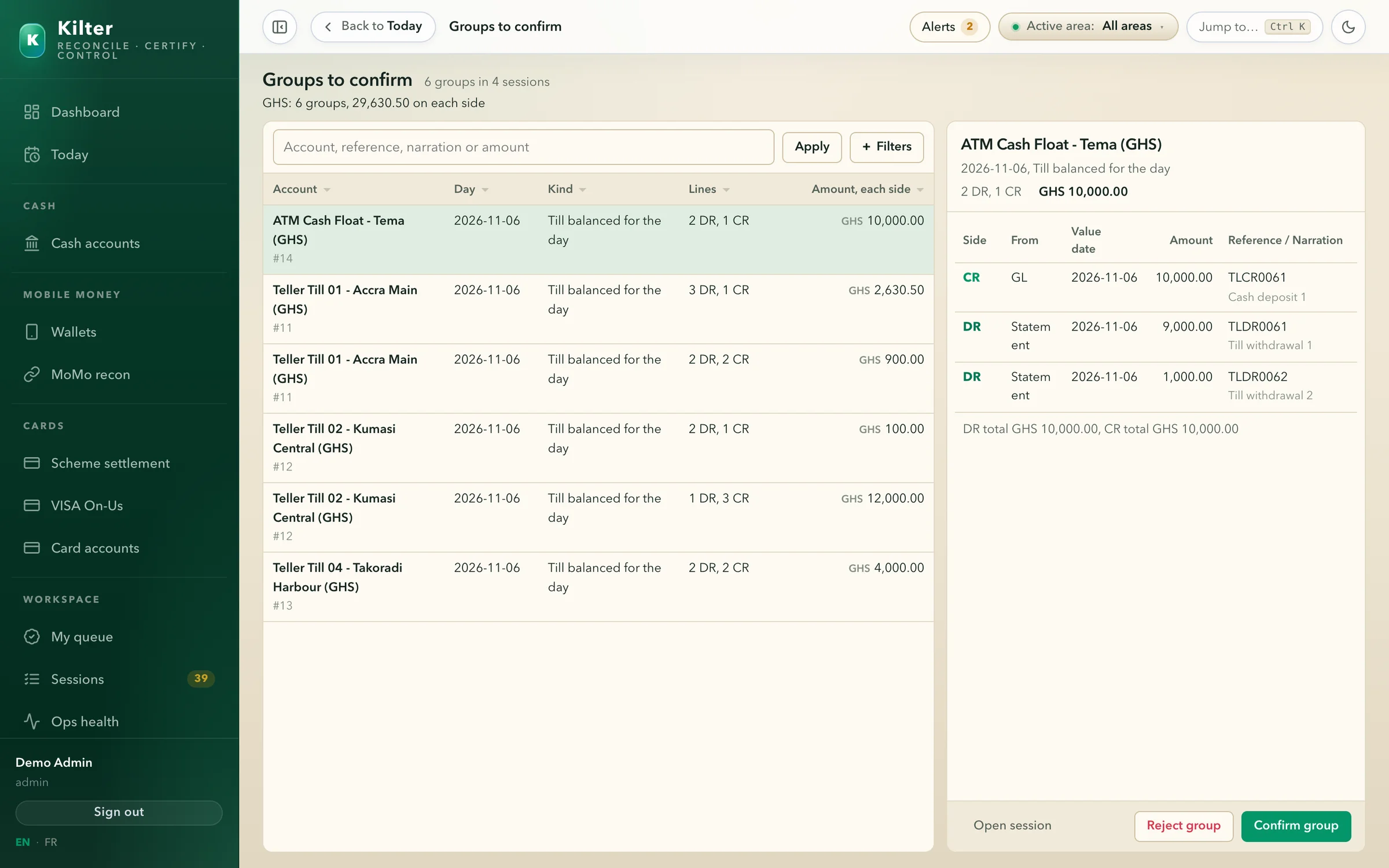
Balanced groups
Whole deals matched, reviewed and confirmed as one balanced group — with net, principal + interest and settlement-lump cases explained.
New
Groups-to-confirm queue
A desk queue for balanced groups, with confirm-all for balanced days and review counts that count cards, not lines.
New
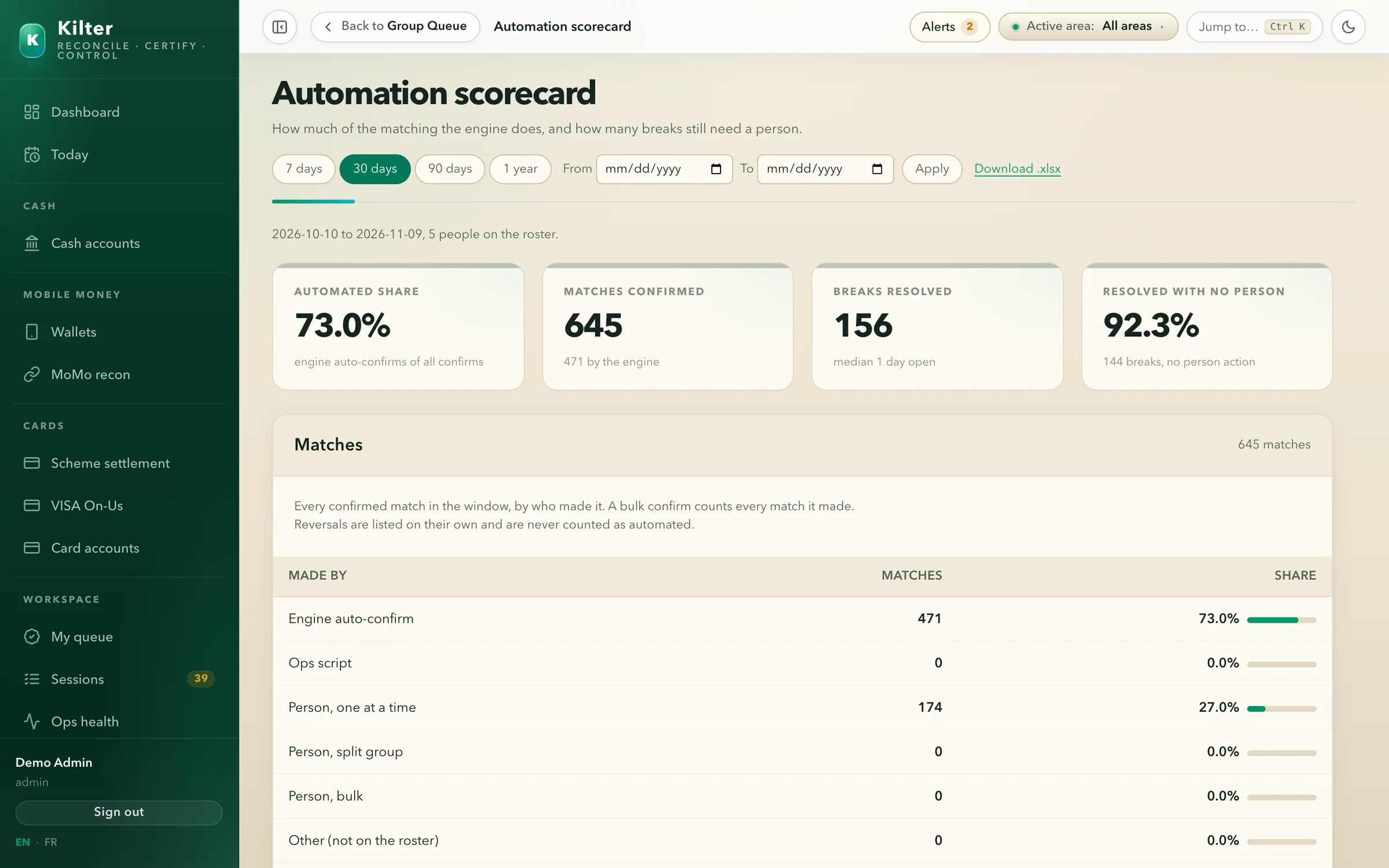
Automation scorecard
See how much is automated, per account and area. Assist suggestions earn promotion through a scorecard gate.
New
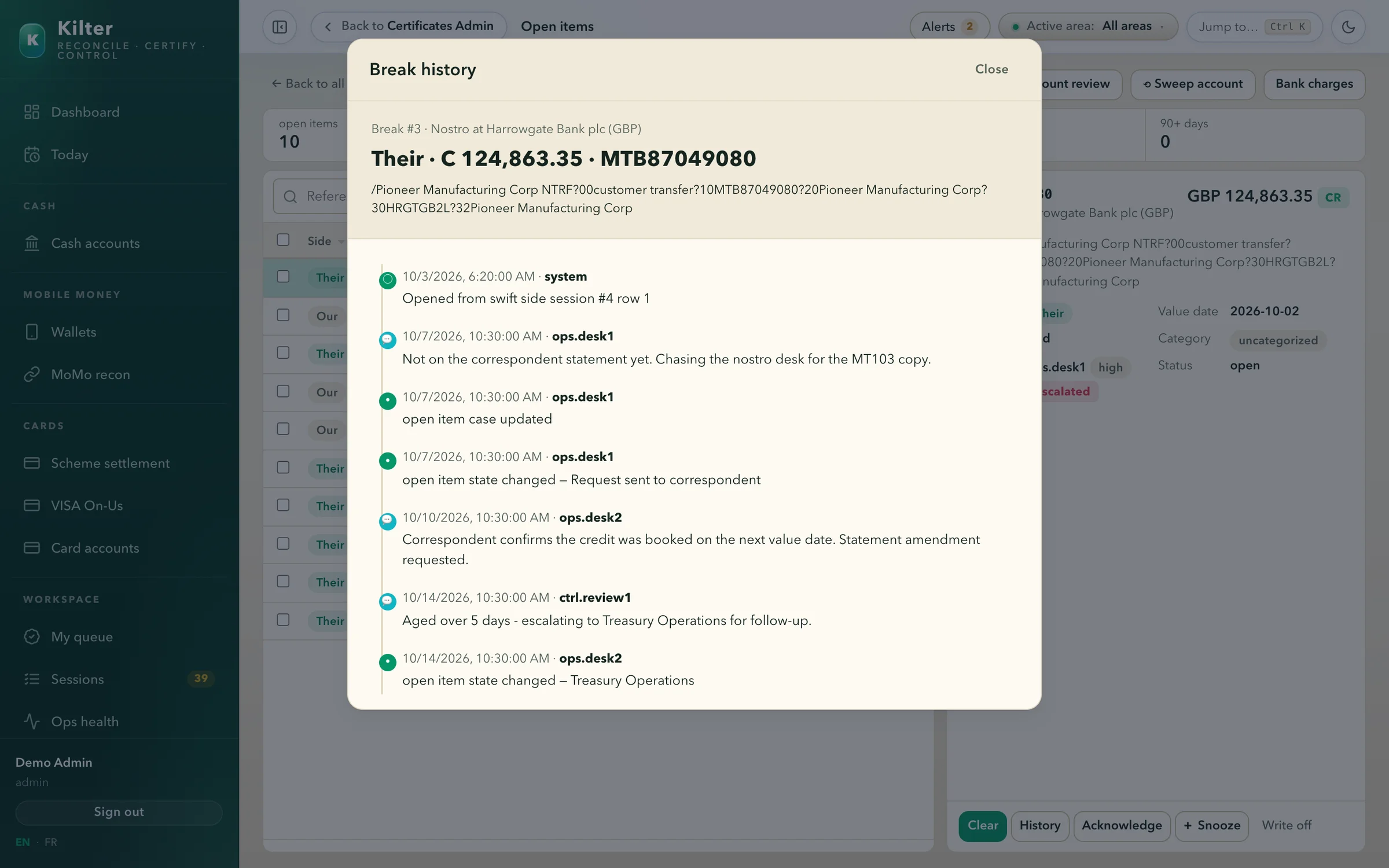
Break history & access review
A full audit trail per open item, and a periodic access review in English and French.
New
Certificate readiness
A readiness checklist before you sign, one lock per session, and an auditable way to supersede a signed certificate.
New
Regulatory mapping
Controls mapped to Bank of Ghana requirements, BCBS 239, ISO 20022 and DORA — evidence for your compliance team.
Five streams, one platform
Four reconciliation tools, replaced by one.
Cash, Cards and Mobile Money run as three separated modules — each with its own routing rule and lock — on the same operator UI, audit log, role model and deployment. Train a team once and they can work any queue.
01
Nostro / GL
Reads raw SWIFT (MT940/950 · MT942 · MT900) and ISO 20022 (camt.052/053/054) directly — no transformation layer to license or configure — then pairs them against your core-banking GL extract. Four-tier engine — 75–85% auto-match on typical production data.
Cash tills balanced by day, as their own module with its own routing rule and lock. A till guard stops till lines from ever pairing across book days.
Till balancing by dayTill guardOwn routing rule + lock
03
Mobile Money
Ingests operator B2W / W2B feeds directly, pairing legs by msisdn in the narration. Pre-seeded profiles for the major networks. Wallets and switch reconciliation sit on one two-tab page.
MTN MoMoM-PesaAirtel MoneyTelcelGhIPSS
04
Card Scheme
N-way matching on scheme-ref, with card-scheme settlement lumps auto-cleared under strict rules only. PCI-DSS storage scope reduction built-in — full PAN never persists, masked at the parser seam.
Visa Base IIMastercard IPMVerve / GhIPSSMasked PAN
05
Securities / CSD
Holdings proven · CSD connector
Reconciles a Central Securities Depository statement of holdings against your investment ledger — matched on ISIN, nominal and maturity. The settlement cash leg is native nostro recon today; native CSD message ingestion (MT535 · semt) is a scoped connector.
The same engine that reconciles your nostro statements pairs a Central Securities Depository statement of holdings against your investment ledger — position by position, on ISIN, nominal and maturity. The settlement cash leg is already native nostro recon.
Break — held for reviewNominal under-bookedGHS 3,000,000
At CSD, not on the bookUnbooked allotmentGHS 20,000,000
On the book, not at CSDMatured / stale positionGHS 4,000,000
ISIN → reference · nominal → amount · maturity → value date. Tier-1 only auto-confirms — the break stays for human review.
One platform
One operator surface, every stream.
Train once
A team trained on nostro recon can work the mobile-money or cards queue the same day.
Same UI, same shortcuts, same review flow — every module behind one operator surface.
Nostro / GL Cash Mobile Money Card Scheme
Same audit log
Every decision across every stream lands in one tamper-evident, UTC-stamped trail.
Same role model
Maker / checker, five roles, segregation of duties — identical everywhere.
Same deployment
One self-hosted instance on your VM. No extra services to run.
Unlimited users
No per-seat fees, ever. Pay by capacity, not headcount.
Month-end certificates
Frozen, signed snapshots — figures never shift after sign-off.
Operator workflow
Built for the desk, not just the report.
Today page + Home board
Start the day on what needs attention, then see the whole book on one board — before you open a single queue.
Groups to confirm
A desk queue of whole deals: review each as one balanced group, or confirm-all for balanced days. Counts are cards, not lines.
Automation scorecard
How much is automated, per account and area. Assist suggestions are promoted only after a gate: 3 independent deciders and 5,000 labels.
Break history
The full audit trail for every open item — each touch, who made it and when — one click from the break.
Command palette
Ctrl+K to jump anywhere from the keyboard. Reverse a match with a reason, or build a group by hand, without leaving the flow.
Two-sided matching · live
Watch the match happen.
The correspondent's SWIFT statement on the left, your core-banking GL on the right. Lines draw between pairs as the engine runs — tier-graded, with variances and breaks flagged.
SWIFT statement
GL extract
USD 312,450.00MTB-2616-0001C
T1
DR312,450.00H98-EOD-0001
USD 248,900.75MTB-2616-0002C
T1
DR248,900.75H98-EOD-0002
USD 197,300.25MTB-2616-0003C
T2 · Δ120
DR197,180.25H98-EOD-0003
USD 154,200.00MTB-2616-0004C
✗
DRunmatchedbreak · investigate
75–85% auto-matched on production dataFour-tier engine · T1 auto-confirm
The matching engine
Match aggressively, surface only what's ambiguous.
Four tiers, strongest-first. Operators review the exceptions; the engine handles the rest — tolerance windows, FX rounding, date drift.
0–85%auto-matched at Tier 1 on typical production data
T1
Exact reference match
SWIFT TRN / scheme ref + amount within tolerance
75–85%
T2
Amount + date window
Settlement amount within ±N days; per-account
+8–12%
T3
Partial reference / narrative
Normalised substring match with amount confirm
+3–6%
T4
Human review queue
Ranked by confidence — operator confirms
100%
Beyond pairs
Real settlements aren't one-to-one. The engine isn't either.
Past the four tiers, Kilter reads how banks actually settle — whole deals, netted fees, lumps — and proves each group balances before it is confirmed.
Balanced groups
A whole deal is reviewed and confirmed as one group. Payment and fees match by reference as one balanced group, with late fees linked.
Net match
A gross payment against a net statement line, with the bank charge explained and shown.
Principal + interest
Principal and interest tied out and explained by the deal rate, not left as a variance.
Clearing & settlement lumps
Money-market settlement lumps and ACH / cheque clearing lumps matched as groups. Card-scheme lumps and repeated-attempt sets auto-clear under strict rules only.
Till guard
Cash tills balanced by day never pair across book days — a till line can't be matched to the wrong day.
Guard rails
Large-variance confirms need a second confirm with a written reason. Rejected and reversed pairs are never re-proposed. A narration reader flags shared references, as advice only.
Measured on an anonymised 5.3M-row book: reverse-match lookup ~650 ms → ~0.1 ms; group confirm ~5 s → ~0.3 s.
Enterprise-grade
Built to run inside a bank — not just to match.
Beyond the engine: the controls, resilience and integration a treasury operations team needs before it trusts a reconciliation in production.
Tamper-evident audit chain
Every decision is sealed under chained SHA-256 anchors — any retroactive edit is detectable, and you can re-verify the whole chain on demand.
Four-eyes on every write-off
A maker requests, a different checker approves — enforced by the server, not by policy documents. Certificates add a multi-signer sign-off matrix.
No single point of failure
Active-passive failover on a leader lease with provably zero double-fires. Take the active node down; the standby picks up the schedule.
Onboard from a spreadsheet
Seed opening balances and open-item backlog in minutes — dry-run validated first. Any bank, not just a migration off the incumbent.
Plugs into your MIS
A read-only reporting API — including a dashboard overview endpoint — with revocable machine tokens, and HMAC-signed webhooks that push break events to your systems — only to endpoints you configure. Never to us.
Battle-tested intake
Every real statement pathology becomes a permanent regression test, replayed on every change against PostgreSQL — part of 1,200+ automated tests guarding the engine.
Config packs, draft-first
Matching config lives in packs with revisions. New matching keys are staged as drafts and stay review-only until you trust them; a config change re-runs the open sessions.
Reporting you can hand to audit
Nostro report by account or area, a one-click proof-pack per area as PDF and Excel, and a reconciliation workbook split into “This day” and “Position at date”.
Mapped to the frameworks you answer to
Kilter's controls mapped to Bank of Ghana requirements, BCBS 239, ISO 20022 and DORA — evidence by control, for the bank's own compliance team to assess. A mapping, not a certification.
Security & compliance
Security-reviewed, hardened, audit-ready.
Mandatory TOTP on every login
Microsoft / Google Authenticator out of the box; pair the optional AD / LDAPS layer for full password-plus-TOTP MFA. A replay cache blocks 30-second code reuse.
Non-root, read-only rootfs
Runs as UID 10001, all Linux capabilities dropped, no-new-privileges enforced. Only mounts are writable.
Encrypted at rest
TOTP secrets + SMTP creds protected with Fernet (AES-128-CBC + HMAC-SHA256). Key lives in your secret manager.
Tamper-evident audit log
Every login, upload, match, dispute and export — UTC-stamped, blocked from UPDATE/DELETE at the DB, and sealed under a chained SHA-256 anchor you can re-verify on demand.
PCI-DSS scope reduction
Full PAN never persists — masked to first6 + last4 at the parser seam. No SAD accepted; free-text redacted on ingest.
Self-hosted. No phone-home.
Runs on your VM or private cloud. No telemetry, no data leaves your infrastructure. You own the key and the data.
Read-only API by construction
The reporting API takes scoped, revocable machine tokens (hashed at rest, constant-time compared) — and an automated test walks every route to prove no token can reach a write. Zero write surface, guaranteed by CI.
Segregation of duties, enforced
Maker-checker on write-offs — the most sensitive disposition — enforced by the server, not by policy: a different user must approve, with a full audit trail. Certificates support a multi-signer sign-off matrix.
Signed, controlled egress
Outbound break webhooks are optional, HMAC-SHA256 signed, https-only, and fire solely to the internal endpoints you configure. Verifiable, replay-resistant — and never to us.
Certificate readiness, supersede with audit
A readiness checklist must pass before a certificate can be signed, and one lock holds each session. A signed certificate can be superseded — with the replacement and the reason on the audit trail.
Second confirm on large variances
A large-variance confirm needs a second confirm and a written reason of 10+ characters. Rejected or reversed pairs are never proposed again.
Ops tools sign as the tool
Automated and ops tooling signs actions as the tool itself — never impersonating a person — and periodic access review (EN/FR) keeps the user list honest.
Try it on your own data — today.
Request a demo URL and drop in your own SWIFT, GL extract, mobile-money, or card-switch file. We'll run the engine and show you what week one looks like.